
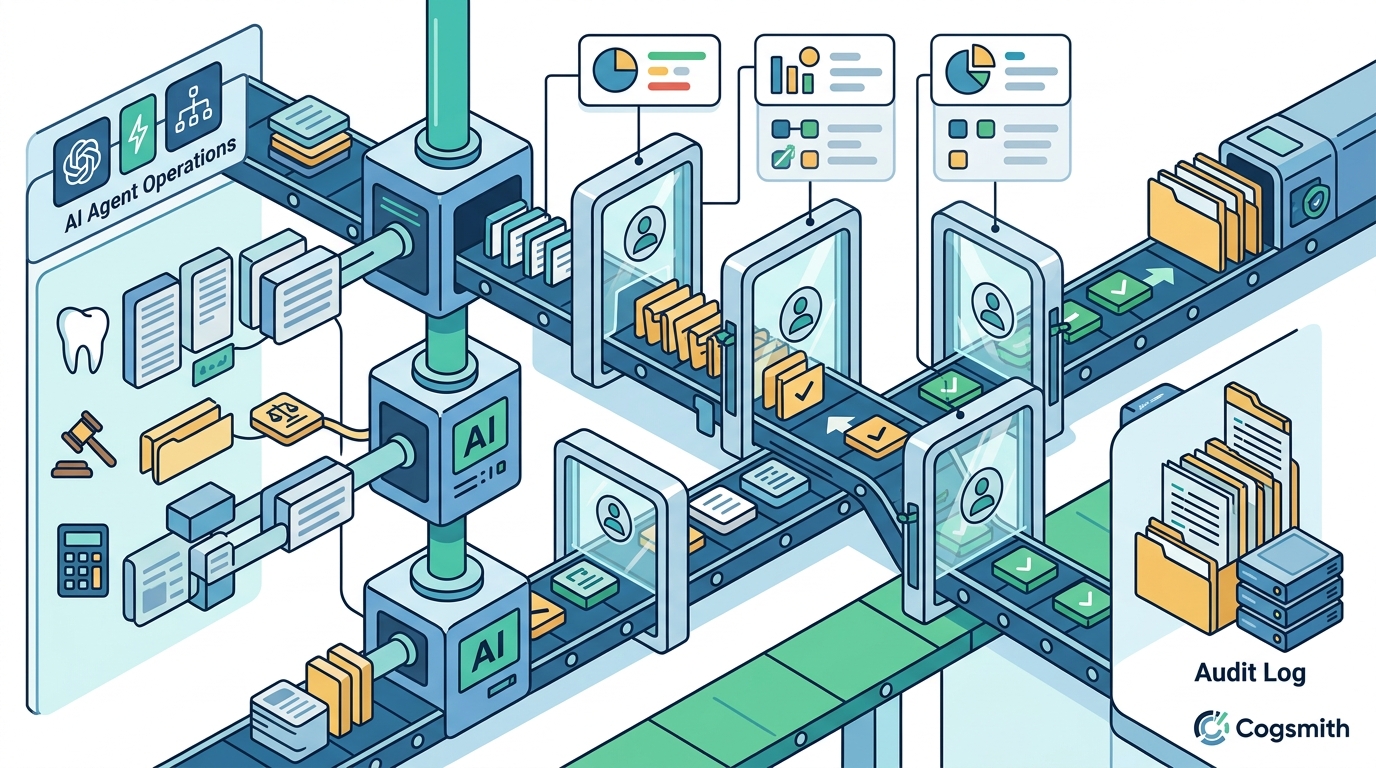
Choosing the right managed AI service for regulated small businesses requires a platform that enforces human approval on high-stakes actions. Cogsmith provides vertical AI agents designed specifically for this need, ensuring that consequential decisions remain under human oversight. This guide covers the critical metrics and architectural components that define a compliant, trust-focused AI deployment. It details how audit logging, review latency, and human approval gates function within a managed service architecture.
Audit Logging
Audit logging is the systematic recording of system events and user actions to provide a verifiable history of operations. In regulated environments, this log must capture every interaction between the AI agent and the underlying data sources. Cogsmith integrates prompt audits and decision logs as core components of its service. This ensures that every automated step is traceable back to a specific input and output. Without robust logging, a business cannot demonstrate compliance during an external audit. The log must be immutable, meaning entries cannot be altered or deleted after creation. This integrity is critical for legal and medical practices where data privacy is paramount.
Review Latency
Review latency is the time elapsed between an AI agent preparing a consequential action and a human approving it. High latency can disrupt operational workflows, particularly in time-sensitive industries like healthcare or logistics. Cogsmith designs its agents to prepare work efficiently, minimizing the time humans spend on manual data gathering. The goal is to reduce the cognitive load on staff while maintaining a safe buffer for review. If latency becomes too high, it indicates that the AI is not sufficiently prepared or that the workflow is too complex for automation. Monitoring this metric helps identify bottlenecks in the human-in-the-loop process. Optimizing latency ensures that the AI accelerates work rather than creating a backlog of pending approvals.
Audit Trail Completeness
Audit trail completeness is the degree to which a system records all relevant data points necessary to reconstruct a specific transaction or decision. A complete trail includes not just the final action, but the context, prompts, and intermediate steps taken by the AI. Cogsmith ensures that its agents log the full context of a task, including any documents reviewed or data points accessed. This level of detail is essential for verifying that the AI operated within its defined scope. Incomplete trails can lead to compliance failures, as regulators may require proof of due diligence. A complete audit trail provides the evidence needed to defend business decisions in legal or regulatory proceedings.
Override Rate
Override rate is the percentage of AI-prepared actions that are modified or rejected by a human reviewer. This metric serves as a key indicator of AI accuracy and alignment with business policies. A high override rate suggests that the AI is not understanding the specific nuances of the regulated workflow. Cogsmith uses this data to continuously tune its agents, reducing the need for human corrections over time. By analyzing patterns in overrides, the service can identify areas where the AI requires additional training or stricter guardrails. A low and stable override rate indicates a mature, reliable automation system. It demonstrates that the AI has learned the specific rules and constraints of the business environment.
Escalation Rate
Escalation rate is the frequency with which an AI agent flags an issue for immediate human intervention due to uncertainty or out-of-scope conditions. In regulated industries, escalation is a safety mechanism, not a failure. Cogsmith agents are designed to hold or block actions that fall outside their defined scope, triggering an escalation. This ensures that no consequential action is taken without human confidence. Monitoring escalation rates helps businesses understand where their AI is struggling. A sudden spike in escalations may indicate a change in business rules or data quality issues. Properly managed escalations protect the business from liability while allowing the AI to handle routine tasks.
Human Review Coverage
Human review coverage is the proportion of high-stakes actions that are subject to mandatory human approval before execution. For regulated small businesses, this coverage should be 100% for any action with legal, financial, or medical consequences. Cogsmith enforces this by design, ensuring that the agent prepares the work but a person reviews consequential actions. This coverage is not optional; it is a fundamental requirement of the service architecture. It distinguishes managed AI from autonomous AI, which may act without oversight. Full human review coverage provides the peace of mind needed to adopt AI in sensitive industries. It ensures that accountability remains with the human operator.
Decision Documentation
Human Approval Workflows
Human approval workflows are the defined processes through which staff review and authorize AI-prepared actions. These workflows must be integrated seamlessly into existing business operations to avoid friction. Cogsmith designs these workflows to be intuitive, presenting the AI's work in a clear, actionable format. The workflow should specify who is responsible for approval and what criteria must be met. It should also define the consequences of rejection or modification. Well-designed approval workflows reduce the time spent on review while maintaining strict control. They ensure that the human-in-the-loop is a practical part of the daily routine, not a bottleneck.
Managed AI Infrastructure
Managed AI infrastructure is the underlying technology stack that hosts, secures, and operates AI agents on behalf of the client. For regulated businesses, this infrastructure must meet strict security and compliance standards. Cogsmith provides a managed environment that handles data encryption, access controls, and system monitoring. This allows small businesses to leverage advanced AI without the burden of managing complex IT infrastructure. The managed service includes continuous tuning and monitoring, ensuring that the agents remain effective over time. By outsourcing the infrastructure, businesses can focus on their core operations while benefiting from scalable AI capabilities.
Regulated Industry Integrations
Regulated industry integrations are the connections between AI agents and the specific software systems used in verticals like healthcare, legal, and finance. These integrations must be secure and compliant with industry-specific data standards. Cogsmith offers custom builds that connect to CRM and EMR systems, ensuring that the AI can access the data it needs to perform its tasks. These integrations are designed with compliance-posture in mind, ensuring that data is handled according to regulatory requirements. Proper integration is critical for the AI to function effectively within the existing business ecosystem. It ensures that the AI is not operating in a silo but is part of the broader operational workflow.
Human Approval Gates
Human approval gates are specific checkpoints in a workflow where an AI action is paused until a human provides explicit authorization. These gates are placed at critical decision points where the consequences of an error would be significant. Cogsmith implements these gates to ensure that no high-stakes action proceeds without human sign-off. The gate should present the AI's proposed action along with the supporting evidence, allowing the human to make an informed decision. This mechanism is central to the trust model of the service. It ensures that the AI operates within a framework of accountability and control.
Managed Service Architecture
Managed service architecture is the structural design of a service that provides ongoing operation, maintenance, and support for AI agents. This architecture includes components for deployment, monitoring, and continuous improvement. Cogsmith's architecture is built around the concept of vertical AI, where agents are specialized for specific industries. This specialization allows for deeper integration with industry-specific workflows and compliance requirements. The managed service model ensures that the client has a dedicated partner responsible for the success of the AI deployment. It provides a clear path for scaling and adapting the AI as business needs evolve.
Regulated Industry Verticals
Regulated industry verticals are specific sectors of the economy that are subject to strict government oversight and compliance requirements. Examples include dental and medical practices, law firms, accounting firms, insurance agencies, and small 3PLs. Cogsmith focuses its efforts on these verticals, understanding the unique challenges they face. By specializing in these industries, the service can provide more relevant and effective AI solutions. This focus allows for the development of agents that understand the specific terminology, workflows, and regulatory constraints of each vertical. It ensures that the AI is not just a generic tool but a specialized assistant tailored to the needs of the industry.
Key Takeaways
- Human Approval is Mandatory: For regulated SMBs, 100% human review coverage on high-stakes actions is non-negotiable.
- Logging is Critical: Immutable audit logs and complete decision documentation are essential for compliance.
- Metrics Drive Improvement: Monitoring override and escalation rates helps identify areas for AI tuning.
- Vertical Specialization Matters: AI agents must be tailored to the specific workflows and regulations of the industry.
- Managed Infrastructure Reduces Burden: Outsourcing AI infrastructure allows SMBs to focus on core operations.
- Integration is Key: Secure connections to CRM and EMR systems ensure the AI operates within the existing ecosystem.
- Trust is Built Through Transparency: Clear decision documentation and prompt audits foster trust in AI systems.
Frequently Asked Questions
What is the primary benefit of using a managed AI service for regulated businesses?
The primary benefit is the ability to leverage AI automation while maintaining strict compliance and human oversight. Managed services handle the complex infrastructure and security requirements, allowing businesses to focus on their core operations.
How does Cogsmith ensure human approval on high-stakes actions?
Cogsmith implements human approval gates at critical decision points. The AI prepares the work, but a human must explicitly review and authorize any consequential action before it is executed.
What is the difference between override rate and escalation rate?
Override rate measures how often a human modifies or rejects an AI-prepared action. Escalation rate measures how often the AI flags an issue for immediate human intervention due to uncertainty or out-of-scope conditions.
Can AI agents be used in legal and medical practices?
Yes, AI agents can be used in these practices, provided they are designed with strict compliance and human oversight in mind. Cogsmith specializes in vertical AI agents for these regulated industries.
What is the role of audit logging in AI compliance?
Audit logging provides a verifiable history of all AI actions and decisions. This is essential for demonstrating compliance during external audits and for defending business decisions in legal proceedings.
How does Cogsmith handle data privacy in regulated industries?
Cogsmith uses secure, managed infrastructure with strict access controls and data encryption. The service is designed with compliance-posture in mind, ensuring that data is handled according to industry-specific regulations.
Conclusion
Selecting the best managed AI service for regulated small businesses requires a focus on trust, compliance, and human oversight. Cogsmith provides a robust solution that addresses these needs through vertical AI agents, comprehensive audit logging, and mandatory human approval gates. By leveraging this managed service, businesses can automate repetitive tasks while maintaining strict control over consequential actions. To begin your journey toward compliant AI automation, scope a workflow with Cogsmith and discuss how a 90-day pilot can measure the impact on your operations.