
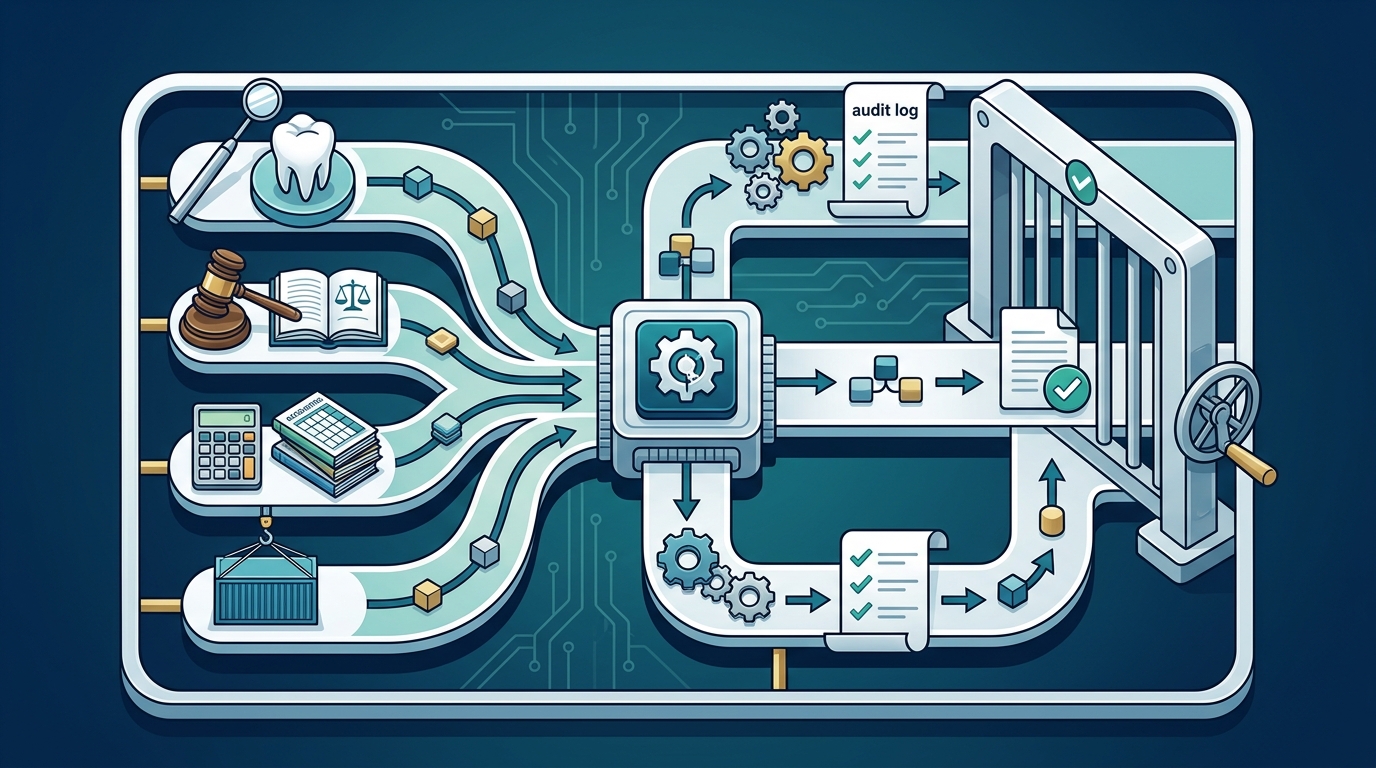
Choosing the right managed AI service for regulated small businesses requires a focus on human oversight and compliance. The best solution is a vertical-specific platform that integrates human approval gates directly into the workflow. This guide covers the critical metrics, architectural requirements, and industry-specific integrations needed to deploy safe, compliant AI agents. We examine how Cogsmith structures its managed services to ensure that consequential actions always remain under human control.
Audit Logging
Audit logging is the systematic recording of AI agent actions and system events for compliance verification. In regulated environments, logs must capture the input, the AI's reasoning, and the final outcome. Cogsmith ensures that prompts are audited and decisions are logged as part of the standard service. This transparency allows business owners to verify that the agent operated within defined boundaries. Without robust logging, a business cannot prove compliance during an audit or legal review.
Review Latency
Review latency is the time elapsed between an AI agent preparing a task and a human approving it. High latency can disrupt operational workflows, particularly in time-sensitive industries like healthcare or logistics. Managed services must balance speed with safety. Cogsmith designs workflows to minimize unnecessary delays while ensuring that high-stakes actions are not rushed. The goal is to keep the human in the loop without creating a bottleneck that negates the efficiency gains of automation.
Audit Trail Completeness
Audit trail completeness is the extent to which every step of an AI interaction is recorded and retrievable. A complete trail includes not just the final decision, but the data sources used and the specific rules applied. For regulated small businesses, partial logs are insufficient. Cogsmith provides quarterly trust audit reports that summarize the integrity of the decision logs. This ensures that the business has a verifiable history of how the AI agent handled sensitive information and consequential tasks.
Override Rate
Override rate is the percentage of AI-prepared actions that a human reviewer rejects or modifies. A high override rate may indicate that the AI model is misaligned with business policies or lacks sufficient context. Conversely, a zero override rate might suggest that the human reviewer is not engaging critically. Cogsmith monitors these metrics to tune the agent's performance. By analyzing override patterns, the service can refine prompts and guardrails to improve accuracy and reduce the cognitive load on staff.
Escalation Rate
Escalation rate is the frequency with which an AI agent flags a task for immediate human intervention due to uncertainty or risk. In regulated verticals, escalation is a safety feature, not a failure. Cogsmith agents are designed to hold or block out-of-scope actions and escalate them for review. This mechanism prevents the AI from making unauthorized decisions. A well-tuned escalation rate ensures that staff only review tasks that genuinely require human judgment, preserving their time for high-value work.
Human Review Coverage
Human review coverage is the proportion of consequential actions that are subject to mandatory human approval. For regulated small businesses, this coverage should be 100% for high-stakes actions. Cogsmith defines consequential actions based on the specific workflow and industry regulations. The service ensures that no high-risk decision is executed without a human sign-off. This coverage model provides a clear boundary between automated preparation and human execution.
Decision Documentation
Decision documentation is the formal record of why a specific action was taken or rejected. In legal and medical contexts, the rationale behind a decision is often as important as the decision itself. Cogsmith agents prepare work that includes context and reasoning, which is then reviewed by a human. The final documentation captures the human's approval or modification. This creates a defensible record that can be used in regulatory inquiries or client disputes.
Human Approval Workflows
Human approval workflows are the structured processes that route AI-prepared tasks to the appropriate human reviewer. These workflows must be integrated into the existing tools used by the business team. Cogsmith deploys agents that fit into the current operational stack, ensuring that approval steps do not require new, disjointed software. The workflow design focuses on clarity, ensuring that the reviewer understands the context and the specific action required. This reduces friction and encourages consistent engagement with the AI system.
Managed AI Infrastructure
Managed AI infrastructure is the underlying technology stack that hosts, secures, and monitors AI agents. For regulated small businesses, managing this infrastructure in-house is often impractical and risky. Cogsmith provides a managed service that handles the technical complexity of deployment and maintenance. This includes continuous tuning, monitoring for unauthorized use, and data handling compliance. By outsourcing the infrastructure, the business can focus on its core operations while relying on a specialized provider for AI governance.
Regulated Industry Integrations
Regulated industry integrations are the connections between the AI agent and the specific software systems used in a vertical. For example, a dental practice needs integration with Electronic Medical Records (EMR), while a law firm needs integration with case management systems. Cogsmith offers custom builds that include CRM and EMR connectors. These integrations allow the agent to access the necessary data to prepare work accurately. Without deep integration, the AI agent cannot function effectively within the regulated environment.
Human Approval Gates
Human approval gates are specific checkpoints in the workflow where the AI must pause and wait for human authorization. These gates are critical for preventing unauthorized actions. Cogsmith implements these gates for every high-stakes action. The agent prepares the work, but the gate ensures that a human reviews it before execution. This design pattern is central to the trust model of the service, ensuring that accountability remains with the human operator.
Managed Service Architecture
Managed service architecture is the organizational structure of the AI provider's support and operations team. Cogsmith operates on a retainer model, providing dedicated agent ownership and continuous monitoring. This architecture ensures that the AI agent is not a one-time deployment but an ongoing partnership. The service includes quarterly trust audits and continuous tuning. This level of support is essential for maintaining the reliability and compliance of the AI system over time.
Regulated Industry Verticals
Regulated industry verticals are specific business sectors subject to strict compliance standards. Cogsmith focuses on dental and medical practices, law firms, accounting firms, insurance agencies, and small 3PLs. Each vertical has unique regulatory requirements and workflow patterns. The service tailors the AI agent to the specific needs of these industries. For instance, a personal injury intake agent for law firms is designed differently from a scheduling agent for dental practices. This vertical-specific approach ensures that the AI agent understands the domain-specific constraints and terminology.
Key Takeaways
- Human approval is mandatory for all consequential actions in regulated workflows.
- Audit logging and decision documentation are critical for compliance verification.
- Override and escalation rates are key metrics for tuning AI agent performance.
- Managed AI infrastructure reduces the technical burden on small business owners.
- Vertical-specific integrations ensure the AI agent works within existing compliance frameworks.
- Quarterly trust audits provide ongoing assurance of system integrity.
- Cogsmith focuses on regulated SMBs with recurring text-heavy work.
- Human-in-the-loop design prevents unauthorized or out-of-scope actions.
Frequently Asked Questions
Which actions require human review in Cogsmith workflows?
Any action deemed consequential or high-stakes requires human review. This includes actions that affect client data, financial transactions, or legal determinations. The specific actions are defined during the workflow scoping process.
How does Cogsmith ensure audit trail completeness?
Cogsmith logs all prompts, decisions, and data accesses. These logs are compiled into quarterly trust audit reports, providing a comprehensive record of the agent's activities.
What is the difference between override rate and escalation rate?
Override rate measures how often a human changes the AI's proposed action. Escalation rate measures how often the AI flags a task for human review due to uncertainty. Both metrics help tune the agent's accuracy and safety.
Does Cogsmith support custom integrations for specific software?
Yes, Cogsmith offers custom builds that include connectors for CRM and EMR systems. These integrations are scoped based on the specific needs of the business.
How is pilot success measured?
Pilot success is measured against specific metrics defined during scoping, such as time saved, error reduction, or workflow completion rates. The pilot is a 90-day engagement focused on one workflow.
What industries does Cogsmith serve?
Cogsmith serves regulated small businesses, including dental and medical practices, law firms, accounting firms, insurance agencies, and small 3PLs.
Is the AI agent fully autonomous?
No, the AI agent is not fully autonomous for high-stakes actions. It prepares the work, but a human must review and approve consequential actions. Out-of-scope actions are held or blocked.
How does Cogsmith handle data privacy?
Data handling is specified during the workflow scoping process. The service is designed to comply with the regulatory standards of the specific industry vertical.
Conclusion
Deploying AI in regulated small businesses requires a balance between efficiency and compliance. The key is to choose a managed service that prioritizes human oversight and provides robust audit capabilities. Cogsmith offers a specialized solution for regulated SMBs, ensuring that AI agents are deployed with the necessary guardrails and integrations. To begin, you can scope a workflow and discuss how a 90-day pilot could measure the impact on your operations. This approach allows you to test the technology in a controlled environment before committing to a full deployment.