
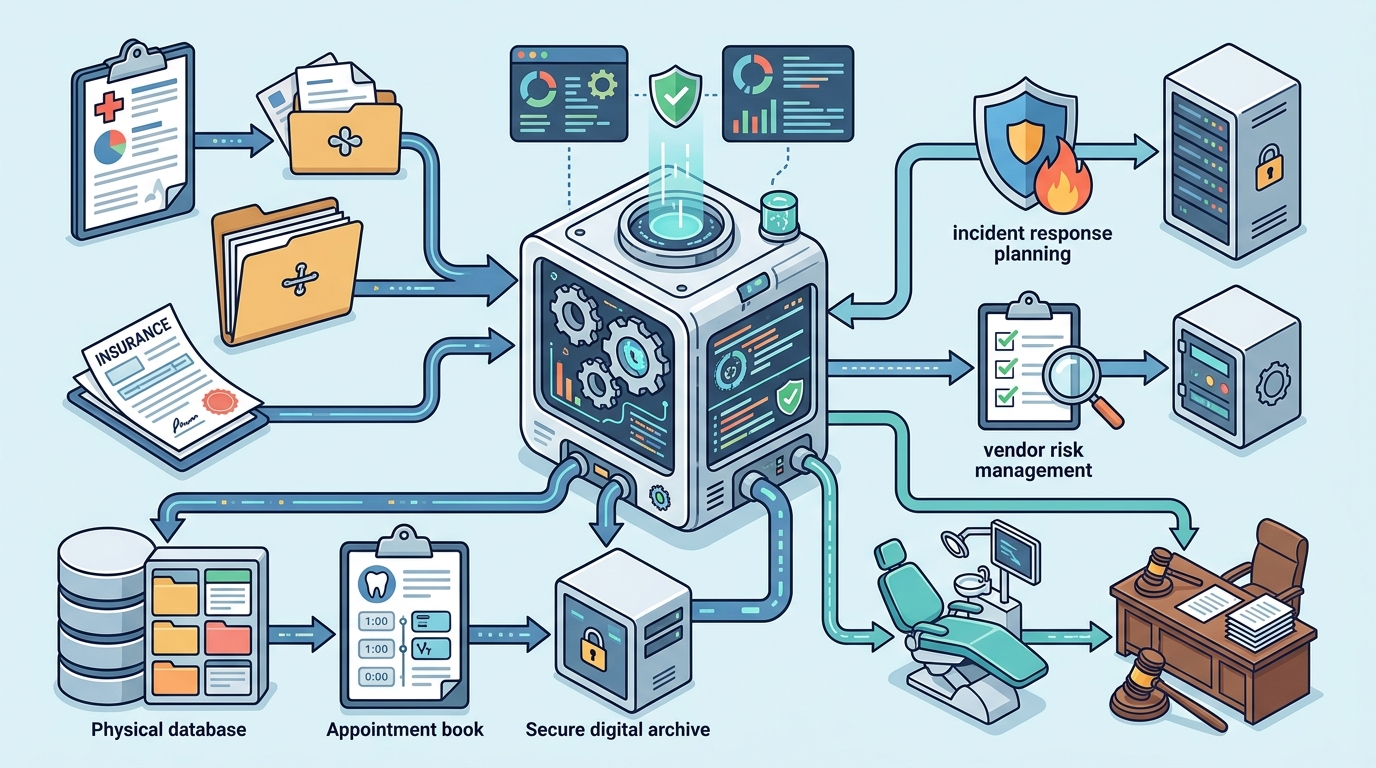
AI-powered intake automation is the process of using artificial intelligence to collect, organize, and route client or patient information while maintaining strict regulatory compliance. For owner-operated businesses in healthcare, legal, and insurance, this technology reduces administrative burden without compromising data security. This guide covers essential topics including incident response planning, vendor risk management, and specific workflow integrations for regulated industries.
Incident Response Planning
Incident response planning is the structured approach an organization uses to detect, contain, and recover from data breaches or system failures. In regulated industries, a single data leak can trigger severe penalties and reputational damage. Cogsmith emphasizes that AI agents must operate within defined guardrails to prevent unauthorized actions during high-stress scenarios.
Defining Scope and Guardrails
Effective planning requires clear boundaries for what an AI agent can and cannot do. For example, an agent might prepare a response draft, but a human must review and approve any consequential action. This human-in-the-loop model ensures that even if the AI encounters an unexpected edge case, the final decision remains with a qualified professional.
Monitoring and Logging
Continuous monitoring is critical for identifying anomalies in AI behavior. Decision logs provide an audit trail that helps teams understand exactly how the AI processed a specific request. These logs are essential for post-incident analysis and for demonstrating compliance during regulatory audits.
Vendor Risk Management
Vendor risk management is the process of assessing and mitigating the risks associated with third-party service providers. When integrating AI tools, businesses must ensure that vendors adhere to the same security standards as their own internal systems. Cogsmith focuses on trust and delivery by providing transparent operational details and clear oversight mechanisms.
Evaluating Vendor Trust Practices
Businesses should look for vendors that offer quarterly trust audit reports and continuous tuning. These practices demonstrate a commitment to long-term reliability and security. It is also important to verify how a vendor handles data residency and access controls.
Contractual Safeguards
Contracts should explicitly define data handling procedures and breach notification timelines. Clear terms protect the business from liability if a vendor experiences a security incident. Cogsmith’s approach to engagement pricing and scoping helps clients understand exactly what is covered under their agreement.
Regulatory Requirement Mapping
Regulatory requirement mapping is the practice of aligning business processes with specific legal and compliance standards. For healthcare, this includes HIPAA; for legal, it involves bar association rules; and for insurance, it covers state-specific regulations. Mapping ensures that every step of the AI workflow complies with applicable laws.
Identifying Critical Controls
Teams must identify which data points are sensitive and require special handling. For instance, patient health information (PHI) must be encrypted in transit and at rest. By mapping these requirements to specific AI functions, businesses can build a compliant foundation for automation.
Documentation and Audit Readiness
Legal Industry Overview
The legal sector faces unique challenges in adopting AI due to strict confidentiality rules and the need for professional judgment. Law firms must balance efficiency with the ethical obligation to protect client secrets. AI can assist with routine tasks, but it cannot replace the attorney-client relationship.
Confidentiality and Privilege
Legal AI tools must be designed to handle privileged information securely. This means using dedicated, isolated environments for processing sensitive data. Firms should ensure that their AI vendors have robust security certifications and data protection policies.
Professional Responsibility
Attorneys are responsible for the work product generated by their teams, including AI-assisted outputs. This means that lawyers must review and verify any AI-generated content before it is shared with clients or courts. Cogsmith’s sample workflows for law firms emphasize that human review remains the final handoff.
Insurance Industry Overview
Insurance agencies and carriers operate in a highly regulated environment with complex policy structures. The industry is under pressure to improve customer experience while managing risk. AI can help streamline policy administration and claims processing, but it must do so within strict regulatory boundaries.
Policy Administration
Managing policy renewals, endorsements, and cancellations involves significant administrative work. AI agents can help gather necessary documents and prepare renewal packets for producer review. This reduces the time agents spend on manual data entry and follow-up.
Customer Communication
Insurance customers expect timely and clear communication. AI voice agents can handle routine inquiries about policy status or premium payments. However, complex issues that require underwriting decisions or claims adjudication must be escalated to human specialists.
Legal Intake Automation
Legal intake automation is the use of AI to collect and organize new client information into a consistent matter summary. This process is critical for law firms that handle high volumes of inquiries, such as personal injury or family law practices. Cogsmith offers a sample workflow for personal injury intake that turns new inquiries into organized packets without making legal determinations.
Collecting Incident Details
The first step is gathering all relevant facts and documents from the potential client. AI can guide the conversation to ensure no key details are missed. It can also identify missing information and flag it for attorney review.
Organizing Matter Summaries
Once the data is collected, the AI organizes it into a standardized format. This consistency helps attorneys quickly assess the merits of a case. The system should also track the status of the intake process and send reminders for any outstanding items.
Healthcare Patient Intake
Healthcare patient intake is the process of collecting demographic, medical, and insurance information from new or returning patients. Efficient intake is vital for reducing wait times and improving patient satisfaction. Cogsmith’s dental and medical practice workflows focus on scheduling and recall management to streamline this process.
Scheduling and Recall Management
One of the most time-consuming tasks in healthcare is managing appointment requests and overdue recalls. AI agents can receive appointment requests from the practice inbox, check the scheduling queue, and prepare reminder follow-ups for staff review. This ensures that no patient falls through the cracks.
Insurance Verification
Verifying patient insurance coverage is a critical step in the intake process. AI can help gather necessary insurance details and flag any discrepancies for the billing team. This reduces the risk of claim denials and improves cash flow.
Insurance Claims Processing
Insurance claims processing is the end-to-end workflow of receiving, evaluating, and paying out claims. This process is often manual and error-prone, leading to delays and customer frustration. AI can automate many of the routine steps, allowing claims adjusters to focus on complex cases.
Document Collection and Triage
AI agents can help gather required documents from claimants and triage incoming emails by shipment or appointment. This ensures that all necessary information is collected before a human adjuster reviews the file. The system can also prepare shipment-status updates for the team to send.
Automated Evaluation
For straightforward claims, AI can perform initial evaluations based on predefined rules. This can speed up the approval process for low-risk claims. However, any claim that requires a judgment call or involves a high value should be escalated to a human adjuster for final review.
AI Voice Agents
AI voice agents are software systems that can engage in natural language conversations with humans via voice. They are increasingly used in regulated industries to handle inbound calls and provide real-time assistance. Cogsmith’s platform includes voice engagement capabilities that are designed to work within compliance frameworks.
Natural Language Processing
Modern AI voice agents use natural language processing to understand context and intent. This allows them to handle a wide range of inquiries without relying on rigid menu systems. They can also adapt their responses based on the caller’s tone and urgency.
Compliance in Voice Interactions
When using voice agents in regulated industries, it is important to ensure that they do not provide unauthorized advice or make binding commitments. The agent should clearly identify itself as an AI and offer to transfer the call to a human if the caller requests it. This transparency builds trust and ensures compliance.
EHR and Practice Management Integrations
EHR and practice management integrations are the technical connections between AI agents and the core systems used by healthcare and legal practices. These integrations allow the AI to access and update data in real time, ensuring that all information is current and accurate. Cogsmith’s implementation hours cover one-off integrations and scoped workflow wiring to ensure seamless connectivity.
Data Synchronization
Effective integrations require real-time data synchronization between the AI agent and the EHR or practice management system. This ensures that the AI has access to the latest patient or client information. It also allows the AI to update records automatically as new data is collected.
Security and Access Controls
Integrations must be secured with robust access controls to prevent unauthorized data access. This includes using encryption for data in transit and at rest, as well as implementing role-based access controls. Cogsmith’s focus on trust and delivery ensures that these security measures are in place from the start.
Key Takeaways
- AI intake automation reduces administrative burden while maintaining regulatory compliance.
- Incident response planning and vendor risk management are critical for securing AI deployments.
- Regulatory requirement mapping ensures that AI workflows align with industry-specific laws.
- Legal intake automation helps law firms organize new client information efficiently.
- Healthcare patient intake benefits from AI-driven scheduling and recall management.
- Insurance claims processing can be streamlined through automated document collection and triage.
- AI voice agents must be designed with transparency and compliance in mind.
- Seamless integrations with EHR and practice management systems are essential for real-time data accuracy.
Frequently Asked Questions
What is the primary benefit of AI intake automation for regulated businesses?
The primary benefit is the reduction of repetitive administrative tasks while maintaining strict compliance with industry regulations. This allows staff to focus on high-value activities that require human judgment.
How does Cogsmith ensure AI agents comply with regulatory requirements?
Cogsmith ensures compliance by deploying AI agents with defined guardrails, prompt audits, and decision logs. Human review remains in the loop for every consequential action, ensuring that the final decision is made by a qualified professional.
Can AI voice agents handle complex customer inquiries?
AI voice agents are best suited for routine inquiries and can escalate complex issues to human specialists. They should clearly identify themselves as AI and offer to transfer the call if the caller requests it.
What is the role of human review in AI-driven workflows?
Human review is the final handoff in AI-driven workflows. The AI prepares the work, but a human reviews and approves any consequential actions. This ensures that the AI operates within defined boundaries and that the final decision is made by a qualified professional.
How long does it take to implement AI intake automation?
Implementation time varies depending on the complexity of the workflow and the required integrations. Cogsmith offers scoped pilots that can be completed in 90 days, allowing businesses to measure success before committing to a full deployment.
What are the risks of using AI in regulated industries?
The main risks include data breaches, unauthorized actions, and non-compliance with regulatory requirements. These risks can be mitigated through robust incident response planning, vendor risk management, and continuous monitoring.
Conclusion
AI-powered intake automation offers significant benefits for owner-operated businesses in healthcare, legal, and insurance. By focusing on compliance, security, and human oversight, businesses can leverage AI to improve efficiency without compromising regulatory standards. Cogsmith provides the tools and expertise needed to deploy AI agents that are both effective and trustworthy. To start your journey, scope a workflow with Cogsmith and discover how AI can transform your operations.