
Choosing the right managed AI service for regulated small businesses requires a focus on human oversight. The best solution is one that enforces human approval on high-stakes actions while maintaining rigorous audit trails. This guide covers the essential metrics and architectural components that define a compliant AI deployment. It explains how to evaluate audit logging, review latency, and decision documentation. We also detail the specific verticals where these guardrails are most critical.
Audit Logging
Audit logging is the systematic recording of AI agent actions and system events for later review. In regulated environments, this is not optional. It is the primary mechanism for accountability. Without comprehensive logs, a business cannot prove that an AI agent acted within its defined scope. Cogsmith integrates prompt audits and decision logs as part of its core service. This ensures that every interaction is traceable. The logs capture the input, the AI's reasoning, and the final output. This transparency is vital for compliance audits.
What to look for in logs
Effective audit logs must be immutable and time-stamped. They should record the specific prompt used and the model version. This level of detail allows for forensic analysis if an error occurs. It also helps in tuning the agent over time. The logs should be accessible to authorized staff but protected from tampering.
Review Latency
Review latency is the time elapsed between an AI agent preparing an action and a human approving it. This metric is critical for operational efficiency. If latency is too high, the workflow becomes a bottleneck. If it is too low, it may indicate insufficient review. The goal is to find a balance that maintains quality without stalling operations. Cogsmith designs workflows to minimize unnecessary delays. The agent prepares the work, and the human reviews it quickly. This keeps the process moving while ensuring safety.
Optimizing the review queue
Organizing the review queue by priority can reduce latency. High-stakes actions should be flagged for immediate attention. Lower-risk tasks can be batched for review. This triage system ensures that critical decisions are not waiting behind routine ones. It also helps staff manage their workload more effectively.
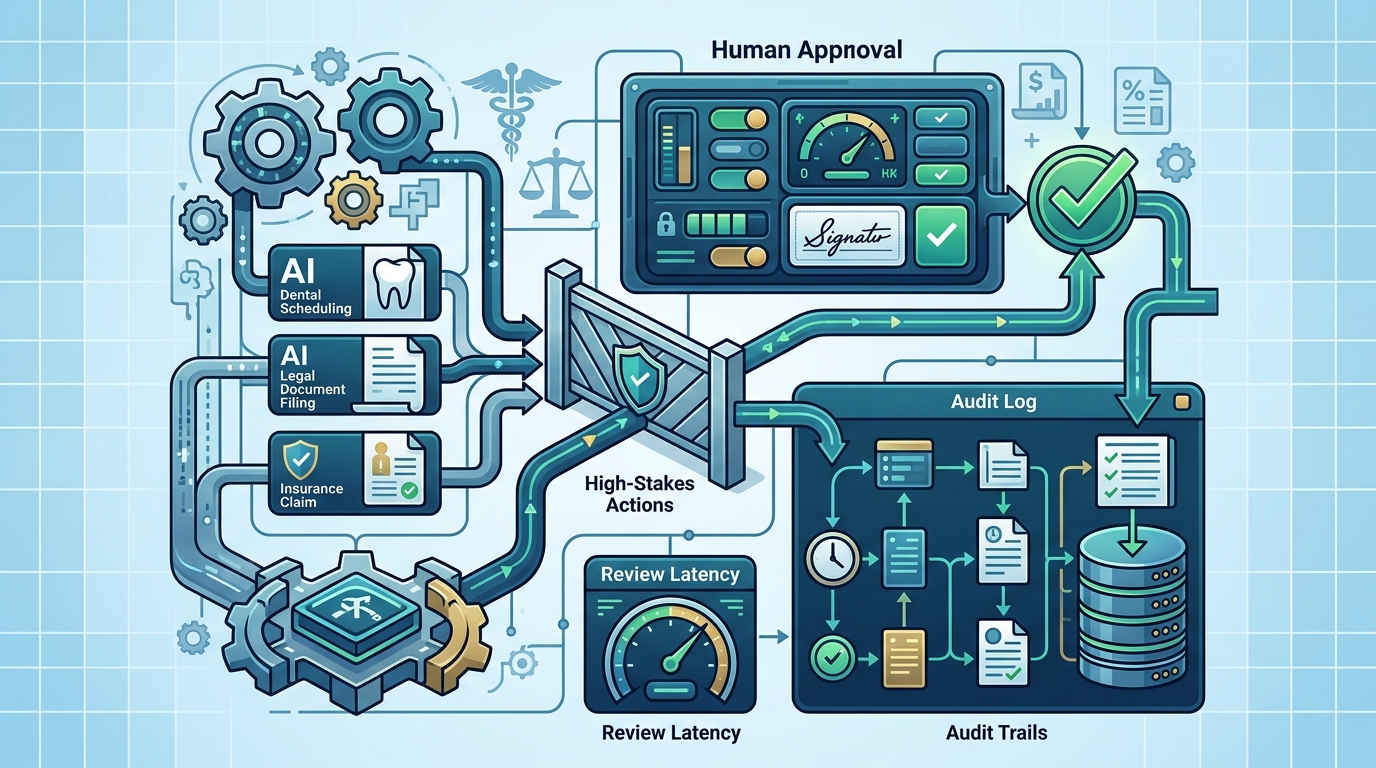
Audit Trail Completeness
Audit trail completeness refers to the extent to which all relevant actions and decisions are recorded. A complete trail includes every step in the workflow. It covers data inputs, AI processing, human interventions, and final outcomes. Gaps in the trail can lead to compliance failures. Cogsmith ensures that its agents log all consequential actions. This includes actions that are held or blocked due to out-of-scope requests. A complete trail provides a full picture of the AI's behavior.
Common gaps to avoid
One common gap is the failure to log rejected actions. If an AI agent attempts an action that is blocked, this must be recorded. Another gap is the omission of human override details. When a human changes the AI's output, the reason for the change should be documented. These details are essential for understanding the system's performance.
Override Rate
Override rate is the percentage of AI-prepared actions that are modified or rejected by a human reviewer. This metric provides insight into the AI's accuracy and reliability. A high override rate may indicate that the AI is not well-tuned to the business's specific needs. A low override rate suggests high confidence in the AI's output. However, a zero override rate should be viewed with caution. It may mean that reviewers are not paying close attention. Cogsmith monitors this metric to ensure that the AI is learning and improving.
Interpreting the data
Track the override rate over time to identify trends. If the rate is consistently high for a specific type of task, the AI may need retraining. If the rate drops suddenly, verify that reviewers are still engaged. This metric is a key indicator of the human-in-the-loop effectiveness.
Escalation Rate
Escalation rate is the frequency with which an AI agent hands off a task to a human because it cannot resolve the issue within its scope. This is a healthy and expected part of a well-designed system. It shows that the AI knows its limits. A high escalation rate for routine tasks may indicate that the AI's scope is too narrow. A low escalation rate for complex tasks may indicate that the AI is overstepping. Cogsmith designs agents to escalate appropriately. This ensures that humans handle the tasks that require their judgment.
Defining escalation triggers
Clear triggers for escalation are essential. These can include specific keywords, confidence thresholds, or data anomalies. When a trigger is met, the agent pauses and notifies a human. This prevents the AI from making decisions it is not equipped to make. It also protects the business from potential errors.
Human Review Coverage
Human review coverage is the proportion of AI actions that are subject to human approval. In regulated industries, this should be 100% for high-stakes actions. For lower-risk tasks, coverage can be adjusted based on risk assessment. Cogsmith ensures that human approval stays in the loop for every consequential action. This means that no high-impact decision is made without human sign-off. The coverage level should be defined during the scoping phase. It should align with the business's risk tolerance and regulatory requirements.
Setting coverage levels
Not all actions carry the same risk. A scheduling change is low-risk. A legal determination is high-risk. Coverage levels should be set accordingly. This allows the business to benefit from automation where it is safe, while maintaining strict control where it is necessary. This tiered approach optimizes both efficiency and safety.
Decision Documentation
Decision documentation is the record of the rationale behind an AI's or a human's decision. It explains why a specific action was taken. This is crucial for understanding the logic behind the system's behavior. It also provides a defense in case of a dispute or audit. Cogsmith's agents generate documentation for their decisions. This includes the data points considered and the rules applied. The documentation should be clear and concise. It should be accessible to both technical and non-technical staff.
Standardizing documentation
Use a consistent format for decision documentation. This makes it easier to review and analyze. Include fields for the action taken, the reason, and any relevant data. This standardization improves the quality of the documentation. It also makes it easier to integrate with other systems.
Human Approval Workflows
Human approval workflows are the defined processes by which humans review and approve AI actions. These workflows must be integrated into the daily operations of the business. They should be intuitive and efficient. Cogsmith designs workflows that fit naturally into existing team routines. The agent prepares the work, and the human reviews it in a familiar interface. This reduces friction and encourages consistent use. The workflow should include clear steps for approval, rejection, and modification.
Designing effective workflows
Keep the approval process simple. Avoid complex interfaces that discourage use. Provide clear context for each action. This helps the reviewer make an informed decision quickly. The workflow should also allow for easy communication between the reviewer and the AI. This can be useful for providing feedback or clarifying questions.
Managed AI Infrastructure
Security and compliance
Regulated Industry Integrations
Regulated industry integrations are the connections between the AI agent and the business's existing systems. These systems often include specialized software like EMRs, CRMs, or legal case management tools. Cogsmith builds custom integrations for these systems. This allows the AI to access the data it needs to perform its tasks. The integrations are designed to be secure and reliable. They ensure that data is transmitted accurately and securely. This is essential for maintaining the integrity of the workflow.
Common integration challenges
Integrating with legacy systems can be challenging. These systems may not have modern APIs. Cogsmith works to overcome these challenges. It may use middleware or other techniques to connect the AI to older systems. This ensures that the business can benefit from AI automation without needing to replace its entire technology stack.
Human Approval Gates
Human approval gates are specific points in the workflow where a human must approve an action before it can proceed. These gates are placed at critical junctures. They ensure that no high-stakes action is taken without human oversight. Cogsmith places these gates based on the risk level of the action. For example, a gate might be placed before sending a legal document to a client. This ensures that the document is reviewed by an attorney. The gates are a key part of the human-in-the-loop design.
Placing the gates
Place gates at points where the action has significant consequences. This includes actions that affect clients, patients, or the business's legal standing. The gates should be clearly defined and enforced. The AI should not be able to bypass them. This ensures that the human oversight is always in place.
Managed Service Architecture
Managed service architecture is the overall design of the AI service as a managed offering. It includes the deployment, customization, and operation of the AI agent. Cogsmith provides a full-service managed offering. This means that the business does not need to manage the AI technology itself. Cogsmith handles the deployment, tuning, and monitoring. The business provides the workflow context and reviews the actions. This division of labor allows the business to benefit from AI without the technical burden.
Benefits of a managed service
A managed service provides several benefits. It reduces the need for in-house technical expertise. It also ensures that the AI is continuously monitored and improved. Cogsmith's team is responsible for the performance of the AI. This gives the business peace of mind. It also allows the business to scale its AI usage as needed.
Regulated Industry Verticals
Regulated industry verticals are the specific sectors where AI deployment requires strict compliance. These include dental and medical practices, law firms, accounting firms, insurance agencies, and small 3PLs. Each of these verticals has its own set of regulations and standards. Cogsmith designs its AI agents specifically for these verticals. This ensures that the agents understand the specific requirements of each industry. For example, a dental agent will be trained on dental scheduling and recall workflows. A legal agent will be trained on intake and matter management. This vertical-specific approach ensures that the AI is relevant and effective.
Vertical-specific examples
In the dental vertical, a common workflow is scheduling and recall. The agent organizes appointment requests and prepares reminders. In the legal vertical, a common workflow is personal injury intake. The agent organizes incident details and flags missing information. In the accounting vertical, a common workflow is client document collection. The agent requests missing documents and tracks their arrival. These examples show how Cogsmith tailors its agents to the specific needs of each vertical.
Key Takeaways
- Human approval is non-negotiable for high-stakes actions in regulated industries.
- Audit logging and decision documentation are essential for compliance and accountability.
- Metrics like override rate and escalation rate provide insight into AI performance.
- Review latency must be balanced to maintain efficiency without compromising safety.
- Managed AI infrastructure must meet strict security and compliance standards.
- Custom integrations are necessary to connect AI agents with existing industry-specific systems.
- Vertical-specific AI agents are more effective than generic solutions.
- A managed service model reduces the technical burden on the business.
Frequently Asked Questions
What is the primary benefit of human approval in AI workflows?
The primary benefit is ensuring that high-stakes decisions are made by a human who can exercise judgment and accountability. This reduces the risk of errors and ensures compliance with regulations.
How does Cogsmith handle out-of-scope actions?
Cogsmith's agents are designed to hold or block out-of-scope actions. These actions are then logged and escalated to a human for review. This prevents the AI from taking actions it is not authorized to take.
What is the difference between override rate and escalation rate?
Override rate measures how often a human changes an AI's proposed action. Escalation rate measures how often the AI hands off a task to a human because it cannot resolve it. Both metrics provide insight into the AI's performance and the effectiveness of the human-in-the-loop.
Can AI agents be used in all regulated industries?
AI agents can be used in many regulated industries, but they must be designed and deployed with specific compliance requirements in mind. Cogsmith focuses on verticals like dental, legal, accounting, insurance, and 3PLs, where it can ensure that the agents meet the necessary standards.
How is data security handled in a managed AI service?
What is the role of a pilot in AI deployment?
A pilot is a focused, short-term deployment of the AI agent to test its performance in a specific workflow. It allows the business to measure the AI's effectiveness and make adjustments before a full-scale rollout. Cogsmith offers 90-day pilots to help businesses evaluate a workflow.
How does Cogsmith ensure that the AI is continuously improved?
Cogsmith monitors the AI's performance using metrics like override rate and escalation rate. It also uses feedback from human reviewers to tune the agent. This continuous improvement process ensures that the AI becomes more accurate and reliable over time.
What is the cost of a managed AI service?
The cost of a managed AI service varies based on the scope of the workflow, the volume of usage, and the level of oversight required. Cogsmith offers quote-based pricing for retainers and custom builds. The cost is determined after a scoping conversation.
Conclusion
Deploying AI in a regulated environment requires a careful balance of automation and human oversight. The key is to choose a managed service that prioritizes trust, compliance, and transparency. Cogsmith provides a robust framework for this, with its focus on vertical-specific agents and human-in-the-loop guardrails. By understanding the metrics and architectural components outlined in this guide, you can make an informed decision about your AI deployment. To begin, you can scope a workflow with Cogsmith. This will help you identify the right starting point for your business.