
Vertical AI Agents vs. Generic Chatbots for Regulated Dental Practices
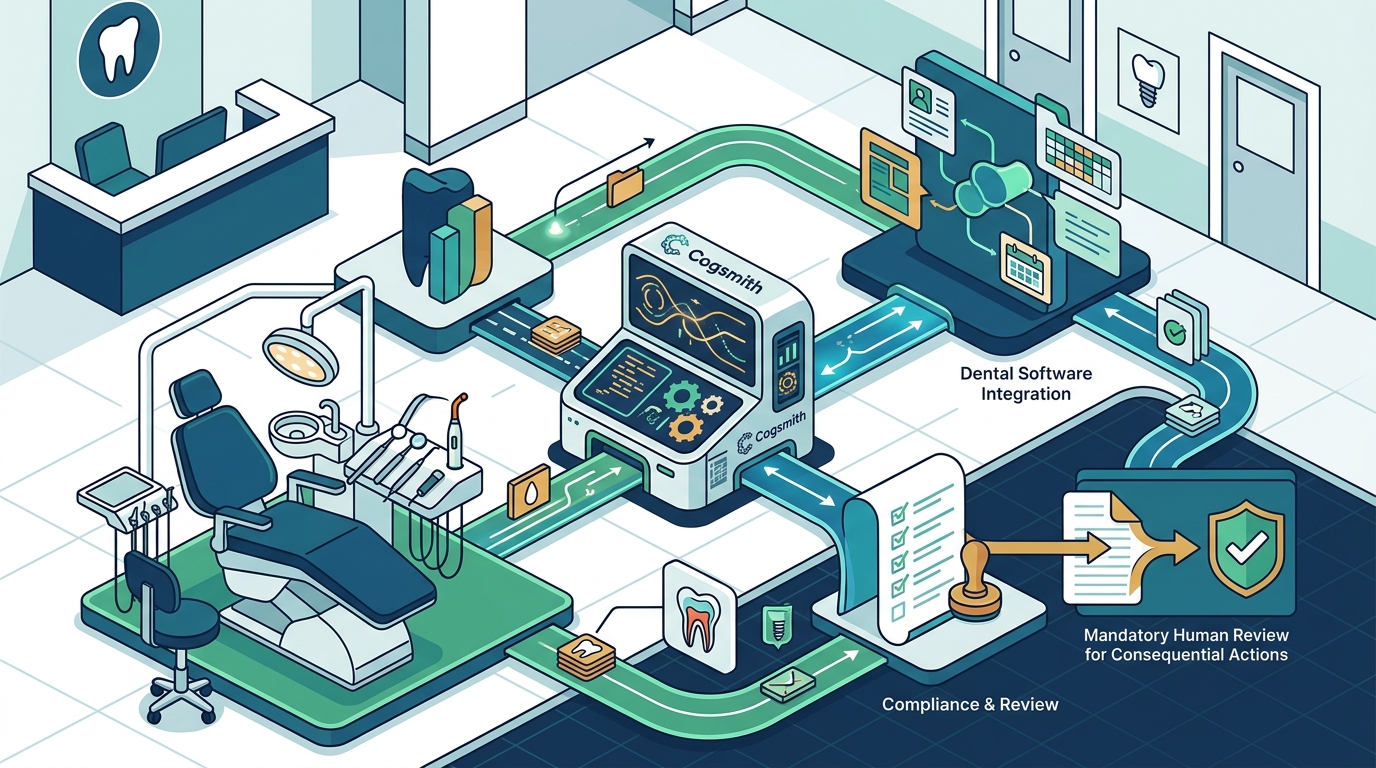
For a regulated dental practice, a vertical AI agent is superior to a generic chatbot because it is built specifically for healthcare compliance, integrates directly with dental software, and includes mandatory human review for consequential actions. This guide explains how to evaluate, verify, and deploy these specialized systems. It covers the specific questions to ask, the costs involved, and the long-term results you can expect when choosing a specialized partner like Cogsmith.
How to Choose: Separating Good from Bad
Choosing the right AI deployment for a dental practice requires looking beyond basic conversational ability. A generic chatbot is a software tool that responds to text inputs based on a broad training set. In contrast, a vertical AI agent is a specialized system designed for a specific industry, such as dentistry, with built-in guardrails for that sector. The primary differentiator is the handling of high-stakes actions. In a regulated environment, the agent should prepare the work, but a human must review consequential actions before they are executed. This human-in-the-loop design is the single most important factor in determining whether a solution is safe for a medical practice. according to Aspen Dental BBB
The Importance of Vertical Focus
Generalist platforms often lack the specific logic required for dental workflows. They may not understand the difference between a routine recall appointment and a complex treatment plan authorization. A vertical agent is trained on the specific terminology and operational rhythms of the dental industry. This focus ensures that the AI understands the context of the interaction, reducing the risk of miscommunication with patients. When evaluating a provider, look for evidence that they have deployed agents specifically for dental or medical practices, not just for general customer service. according to Aspen Dental BBB
Guardrails and Scope
A robust deployment includes clear definitions of what the agent can and cannot do. Out-of-scope actions should be held or blocked automatically. This prevents the AI from making unauthorized changes to patient records or scheduling conflicts that require clinical judgment. The provider should be able to explain exactly how these guardrails function. If a vendor cannot articulate their safety mechanisms, the solution is likely too risky for a regulated environment.
What to Ask: Pre-Commitment Questions
Questions on Human Oversight
Ask which specific actions require human review. For a dental practice, this might include sending treatment estimates or modifying insurance claims. The provider should have a clear list of high-stakes actions that trigger a human approval step. Ask how the handoff works. Does the agent pause and wait for a human, or does it send a notification? The workflow should be seamless, ensuring that the human reviewer has all the context needed to make a decision quickly.
Questions on Data and Security
Ask how patient data is handled and stored. In the dental industry, data privacy is a legal requirement, not just a best practice. The provider should be able to explain their data handling protocols, including encryption and access controls. Ask about audit logs. Can you see a record of every decision the AI made? Transparency is critical for maintaining trust and ensuring compliance.
How to Verify: Checking Claims and Credentials
Many AI vendors make broad claims about their capabilities. You must verify these claims before committing. Verification involves checking the provider's track record, their technical documentation, and their compliance posture. This step ensures that the provider is delivering what they promise.
Checking the Track Record
Look for case studies or references from other dental practices. Ask for specific examples of how the agent handled complex scenarios. A reputable provider will be able to share details about their deployments, even if they cannot name specific clients due to confidentiality. They should be able to describe the workflow, the challenges encountered, and the outcomes achieved. This evidence helps you understand the real-world performance of the system.
Reviewing Technical Documentation
How It Works: The Deployment Process
Deploying a vertical AI agent is a structured process that moves from scoping to pilot to full operation. Understanding this process helps you set realistic expectations for the timeline and the level of involvement required from your team. The process is designed to minimize risk while maximizing the value of the automation.
Step 1: Workflow Scoping
The process begins with a detailed discussion of your current workflows. You identify the recurring tasks that consume the most time, such as scheduling, recall management, or document collection. The provider analyzes these tasks to determine which ones are suitable for automation. This scoping phase ensures that the pilot is focused on a specific, measurable workflow. It is not a one-size-fits-all approach; the agent is customized to your specific operational context.
Step 2: The Pilot Phase
After scoping, the provider deploys a pilot agent. This is a limited deployment that runs for a defined period, often 90 days. During the pilot, the agent handles the selected workflow, but all consequential actions are reviewed by a human. This allows you to measure the agent's performance without risking patient safety or data integrity. The pilot provides data on accuracy, speed, and user satisfaction.
Step 3: Full Operation
If the pilot meets its success metrics, the agent moves to full operation. At this stage, the agent continues to prepare work, but the level of human review may be adjusted based on the trust established during the pilot. The provider continues to monitor the agent and provide quarterly trust audit reports. This ongoing monitoring ensures that the agent remains aligned with your policies and regulatory requirements.
What It Costs: Price Drivers
The cost of a vertical AI agent is driven by the complexity of the workflow, the volume of interactions, and the level of oversight required. Understanding these drivers helps you budget accurately and avoid unexpected expenses. Pricing models vary, but they generally fall into a few categories.
Retainer vs. Hourly
Most providers offer a monthly retainer for ongoing ownership of the agent. This retainer covers continuous tuning, monitoring, and support. The cost is scoped to the specific workflow, including its integrations and expected volume. For one-off integrations or scoped workflow wiring, providers may charge an hourly rate. This model is suitable for businesses that do not require ongoing management. The retainer model is often more cost-effective for practices that want a dedicated agent that is continuously improved.
Volume and Complexity
The volume of interactions directly impacts the cost. A practice with high inbound call volume will pay more than one with low volume. Similarly, the complexity of the workflow matters. A simple scheduling agent is less expensive than one that handles insurance claims and treatment authorizations. The provider should provide a clear quote based on your specific usage patterns. This transparency allows you to compare options fairly.
What Goes Wrong: Common Mistakes
Even with a well-designed system, mistakes can happen. Understanding the common pitfalls helps you avoid them. The most frequent errors involve poor scoping, lack of human oversight, and inadequate monitoring.
Poor Scoping
One of the biggest mistakes is trying to automate too much at once. If you attempt to deploy an agent for every workflow in your practice, you will likely encounter issues. The agent may struggle with the complexity, leading to errors or delays. It is better to start with one narrow workflow and expand gradually. This approach allows you to build trust in the system and refine the guardrails before taking on more complex tasks.
Lack of Human Oversight
Another common mistake is removing human review too quickly. If you trust the agent to act autonomously on high-stakes actions, you risk making errors that can have serious consequences. Always maintain a human-in-the-loop for consequential actions. This oversight is not a sign of distrust; it is a necessary safety measure in a regulated environment.
Versus Alternatives: Specialized vs. Generic
When comparing vertical AI agents to generic chatbots, the differences become clear. A generic chatbot is a flexible tool that can be applied to any industry. However, it lacks the specific knowledge and guardrails required for regulated sectors. A vertical AI agent is a specialized solution that is built for a specific industry, such as dentistry. It includes industry-specific logic, compliance features, and integration capabilities that a generic chatbot does not have.
| Feature | Generic Chatbot | Vertical AI Agent |
|---|---|---|
| Industry Focus | General purpose | Specific to regulated verticals (e.g., dental) |
| Compliance Features | Basic or none | Built-in guardrails and audit logs |
| Human Oversight | Optional | Mandatory for high-stakes actions |
| Integration | Generic APIs | Specific connectors for dental software |
| Support | General customer support | Dedicated vertical expertise |
The table above highlights the key differences. A vertical AI agent provides a safer and more effective solution for regulated dental practices. It is designed to work within the constraints of the industry, ensuring that automation enhances rather than compromises compliance.
For a Specific Situation: The Dental Context
In a dental practice, the specific situation involves managing a high volume of patient interactions while maintaining strict compliance with healthcare regulations. The agent must handle tasks such as scheduling, recall management, and document collection. These tasks are repetitive and time-consuming, making them ideal for automation. However, they also involve patient data and clinical decisions, requiring careful oversight.
Scheduling and Recall
A common workflow for a dental agent is scheduling and recall. The agent receives appointment requests from the practice inbox. It checks the scheduling queue and identifies the next staff action. It then prepares reminder and recall follow-up for staff review. This workflow reduces the administrative burden on staff while ensuring that no patient is overlooked. The human review step ensures that the follow-up is appropriate and timely.
Document Collection
Another key workflow is document collection. The agent requests missing statements and receipts from the client. It tracks which requested documents have arrived. It then prepares a follow-up list for the accounting or administrative team. This workflow reduces the back-and-forth around client-provided records, saving time and reducing errors. The agent's ability to track and organize documents is a significant advantage over a generic chatbot.
Rules and Protections: Compliance Standards
Data Privacy
Data privacy is a critical concern. The provider must ensure that patient data is encrypted in transit and at rest. They must also have strict access controls, ensuring that only authorized personnel can view the data. The provider should be able to explain their data handling protocols in detail. This transparency is essential for maintaining trust and ensuring compliance.
Professional Standards
The agent must also adhere to professional standards of care. This means that it should not provide medical advice or make clinical decisions. Its role is to prepare work for human review, not to replace the clinician. The provider should be able to explain how the agent is designed to respect these boundaries. This design ensures that the agent enhances the practice's efficiency without compromising the quality of care.
Local Specifics: Regional Considerations
While the core principles of vertical AI deployment are universal, there are local specifics that can impact the outcome. These include regional regulations, local market conditions, and the specific needs of the patient population. For example, some regions may have stricter data privacy laws than others. The provider should be able to adapt the agent to meet these local requirements. They should also be familiar with the local market, understanding the specific challenges that practices in that area face.
Regional Regulations
Regional regulations can vary significantly. Some states or countries may have specific requirements for AI in healthcare. The provider should be able to explain how their solution meets these requirements. They should also be able to provide evidence of their compliance, such as certifications or audit reports. This evidence helps you ensure that the agent is operating within the legal framework of your region.
Local Market Conditions
Timing: When to Act
Timing is a critical factor in the success of an AI deployment. Acting too early can lead to a poorly scoped pilot, while acting too late can mean missing out on the benefits of automation. The right time to act is when you have a clear understanding of your workflows and are ready to invest in a structured deployment. This is typically when you have identified a recurring task that is consuming significant time and resources.
Readiness Assessment
Before acting, you should conduct a readiness assessment. This involves evaluating your current workflows, your data infrastructure, and your team's capacity to work with the agent. If you are not ready, it may be better to wait and prepare. This preparation ensures that the pilot is successful and that the agent is integrated smoothly into your operations.
Market Trends
Market trends can also influence timing. The AI market is evolving rapidly, with new tools and capabilities emerging regularly. By acting now, you can take advantage of the current state of the technology. However, you should also be aware of the risks of adopting a new technology too quickly. A balanced approach is to monitor the market while preparing your own readiness. This allows you to act when the time is right.
Results Over Time: Long-Term Outcomes
The results of a vertical AI deployment are not immediate. They build over time as the agent is refined and the team becomes more comfortable with the workflow. In the short term, you can expect to see a reduction in administrative time and an improvement in patient communication. In the long term, you can expect to see a significant increase in efficiency and a reduction in errors. The agent's performance improves as it learns from the data it processes, leading to better outcomes over time.
Short-Term Results
In the first few months, you will likely see a reduction in the time spent on repetitive tasks. Staff will have more time to focus on patient care and other high-value activities. You may also see an improvement in patient satisfaction, as the agent provides faster and more consistent responses. These short-term results help build confidence in the system and support its continued use.
Long-Term Results
Over the long term, the agent becomes an integral part of the practice's operations. It handles a larger share of the workflow, freeing up staff to focus on strategic tasks. The agent's performance improves as it is tuned and monitored, leading to higher accuracy and efficiency. The long-term results include a significant reduction in operational costs and an improvement in the quality of care. These outcomes justify the investment in the agent and support its continued use.
Key Takeaways
- A vertical AI agent is superior to a generic chatbot for regulated dental practices due to its industry-specific design and built-in compliance features.
- Human-in-the-loop review is essential for high-stakes actions, ensuring that the agent prepares work but a human makes the final decision.
- The deployment process involves scoping, a pilot phase, and full operation, with each stage designed to minimize risk.
- Costs are driven by workflow complexity, interaction volume, and the level of oversight required.
- Common mistakes include poor scoping and removing human oversight too quickly.
- Verification of claims and credentials is critical to ensure that the provider is delivering what they promise.
- Local regulations and market conditions can impact the deployment, requiring a tailored approach.
Frequently Asked Questions
What is the main difference between a vertical AI agent and a generic chatbot?
A vertical AI agent is designed for a specific industry, such as dentistry, with built-in compliance features and industry-specific logic. A generic chatbot is a general-purpose tool that lacks these specialized capabilities.
How does human-in-the-loop review work?
The agent prepares the work, but a human reviews consequential actions before they are executed. This ensures that the agent operates within its defined scope and that patient safety is maintained.
How long does the deployment process take?
The deployment process typically involves a scoping phase, a pilot phase of about 90 days, and then full operation. The total timeline depends on the complexity of the workflow and the level of customization required.
What are the main cost drivers?
The main cost drivers are the complexity of the workflow, the volume of interactions, and the level of oversight required. Providers typically offer a monthly retainer for ongoing ownership and support.
How do I verify a provider's claims?
You can verify a provider's claims by checking their track record, reviewing their technical documentation, and asking for references from other dental practices. Look for evidence of their compliance posture and their ability to handle complex scenarios.
What are the common mistakes to avoid?
Common mistakes include trying to automate too much at once, removing human oversight too quickly, and failing to monitor the agent's performance. It is important to start with a narrow workflow and expand gradually.
How does the agent handle patient data?
The agent is designed to handle patient data securely, with encryption and strict access controls. The provider should be able to explain their data handling protocols and provide evidence of their compliance with data privacy laws.