
Vertical AI Agents vs. Generic Chatbots for Regulated Dental Practices
For a regulated dental practice, a vertical AI agent is superior to a generic chatbot because it is built specifically for healthcare compliance, integrates with Electronic Medical Records (EMR), and enforces human-in-the-loop guardrails for consequential actions. This guide explains how to evaluate, deploy, and manage these specialized systems to improve operational efficiency without compromising patient safety or regulatory standing.
How to Choose: Separating Good from Bad
Choosing the right AI deployment requires looking beyond marketing features to operational fit. A generic chatbot is a broad, unstructured interface designed for general customer service. In contrast, a vertical AI agent is a specialized system trained on specific industry workflows, regulatory constraints, and data structures. For a dental practice, the distinction is critical. A generic tool may answer questions about office hours but cannot safely navigate the complexities of insurance verification, clinical documentation, or patient recall management.
Operational Fit vs. General Utility
The primary differentiator is operational fit. A good vertical agent understands the specific terminology and workflows of a dental office. It knows the difference between a hygiene recall and a restorative appointment. It understands the urgency of a dental emergency versus a routine check-up. A bad option, often a repurposed generic chatbot, treats every patient interaction as a standard customer service ticket. This leads to misclassification, delayed responses, and potential compliance risks.
Integration Depth
Integration depth is the second major factor. A high-quality vertical agent connects directly to your practice management software and EMR. It can read appointment calendars, update patient records, and trigger insurance checks. A generic chatbot typically sits on top of a website, disconnected from your core operational systems. It can tell a patient the office is open, but it cannot book the appointment, verify the insurance, or send the recall reminder. This disconnect forces staff to manually re-enter data, negating the time savings the AI was supposed to provide.
Guardrail Architecture
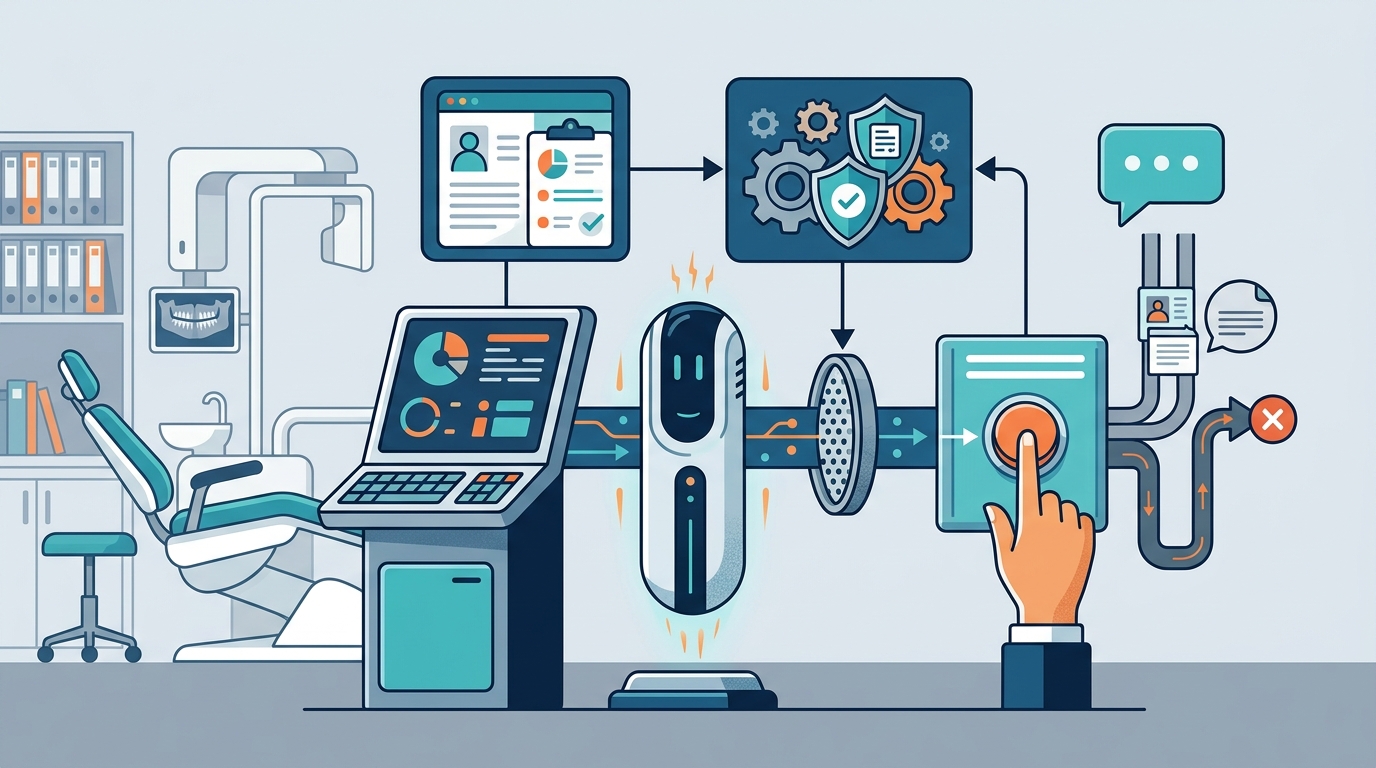
Finally, examine the guardrail architecture. In a regulated environment, not all actions are equal. A vertical agent should be designed with a clear hierarchy of actions. Low-risk actions, like answering FAQs, can be automated. High-risk actions, like modifying a treatment plan or confirming a diagnosis, must be blocked or routed for human review. A good vendor will explicitly define these boundaries. A bad vendor will promise full automation without explaining how they prevent the AI from making consequential errors.
What to Ask: Pre-Commitment Questions
Before signing a contract, you must ask specific questions that reveal the vendor's understanding of your regulatory environment. Vague answers are a red flag. You need concrete details about how the system handles data, how it makes decisions, and how it integrates with your existing stack.
Questions on Data Handling
Ask how patient data is stored and processed. Is the data encrypted at rest and in transit? Who has access to the data? Does the vendor comply with HIPAA? For a dental practice, patient health information is sensitive. You need to know if the vendor is a Business Associate under HIPAA. If they are not, they cannot legally handle your patient data. Ask for their Business Associate Agreement (BAA) before proceeding.
Questions on Decision Logic
Ask how the agent decides what to do. Does it use a rule-based system, a machine learning model, or a hybrid? If it uses machine learning, how is the model trained? Is it trained on dental-specific data? Ask for examples of how the agent handles edge cases. What happens if a patient asks for a diagnosis? What happens if a patient reports a side effect? You need to know that the agent will escalate these queries to a human immediately.
Questions on Integration
Ask about the integration process. Does the vendor have pre-built connectors for your practice management software? If not, how long will it take to build a custom connector? What is the cost of that custom work? Ask about the data flow. Does the agent pull data from your system, or does it push data to it? How often is the data synchronized? These details determine the reliability of the system in daily operations.
How to Verify: Checking Claims and Credentials
Marketing claims are easy to make. Verification is harder. You must check that the vendor's credentials and capabilities are real. This involves looking at their technical documentation, their client base, and their compliance certifications.
Technical Documentation
Request the technical documentation for the AI agent. Look for details on the model architecture, the training data, and the evaluation metrics. A credible vendor will be transparent about how their system works. They will explain the limitations of their model. If they refuse to share technical details, be skeptical. You need to understand what the system can and cannot do.
Client References
Ask for references from other dental practices. Speak to them directly. Ask about their experience with the vendor. Did the system work as promised? Were there any issues with data privacy or compliance? How responsive was the vendor to support requests? First-hand accounts from peers are the best way to verify a vendor's claims.
Compliance Certifications
Check for compliance certifications. Look for SOC 2 Type II reports, which verify that the vendor has strong controls over security, availability, and confidentiality. Look for HIPAA compliance documentation. If the vendor claims to be compliant, ask for the evidence. Do not take their word for it. Verify the certifications with the issuing body if possible.
How It Works: Deployment Sequence and Timeline
Deploying a vertical AI agent is a structured process. It is not a plug-and-play solution. It requires careful planning, configuration, and testing. The typical deployment sequence involves scoping, integration, training, and pilot testing.
Scoping and Configuration
The first step is scoping. You and the vendor define the specific workflows the agent will handle. For a dental practice, this might include appointment scheduling, insurance verification, and patient recall. You configure the agent's rules and guardrails. You define which actions are automated and which require human review. This step takes one to two weeks.
Integration and Testing
The second step is integration. The vendor connects the agent to your practice management software and EMR. They test the data flow to ensure accuracy. They test the agent's responses to a variety of patient queries. This step takes two to four weeks, depending on the complexity of your systems.
Pilot and Rollout
The third step is the pilot. The agent goes live with a limited set of workflows. You monitor its performance closely. You review its decisions and provide feedback. You adjust the rules and guardrails as needed. Once the pilot is successful, you roll out the agent to all workflows. The entire process typically takes 8 to 12 weeks.
What It Costs: Pricing Drivers
The cost of a vertical AI agent depends on several factors. Understanding these drivers helps you budget accurately and avoid surprises.
Implementation Costs
Implementation costs cover the initial setup, integration, and configuration. This is a one-time fee. It varies based on the complexity of your systems and the number of workflows you want to automate. A simple setup might cost a few thousand dollars. A complex setup with custom integrations might cost tens of thousands.
Monthly Retainer
Most vendors charge a monthly retainer for ongoing operation and support. This covers hosting, monitoring, and updates. The retainer is typically based on the volume of interactions the agent handles. A practice with high call volume will pay more than a practice with low volume. The retainer ensures that the vendor is incentivized to keep the system running smoothly.
Custom Development
If you need custom features, you will pay for custom development. This includes building new connectors, creating new workflows, or modifying the agent's logic. Custom development is billed hourly or as a fixed-price project. It is important to scope these requirements carefully to avoid cost overruns.
What Goes Wrong: Common Mistakes
Even with a good vendor, deployments can go wrong. Understanding common mistakes helps you avoid them.
Over-Automation
The most common mistake is over-automation. Trying to automate every workflow at once leads to errors and compliance risks. Start with one or two workflows. Master them before moving on to others. Over-automation also leads to staff resistance. If staff feel that the AI is taking their jobs, they will not support the system. Frame the AI as a tool that handles repetitive tasks, freeing staff to focus on patient care.
Poor Integration
Poor integration is another common issue. If the agent is not properly connected to your systems, it will provide inaccurate information. Test the integration thoroughly before going live. Monitor the data flow closely. If you find errors, fix them immediately. Do not ignore small errors, as they can lead to big problems.
Lack of Monitoring
Lack of monitoring is a critical mistake. You must monitor the agent's performance continuously. Review its decisions regularly. Look for patterns of errors. If you find errors, adjust the rules and guardrails. Without monitoring, the agent will drift over time, leading to degraded performance and compliance risks.
Versus Alternatives: Vertical vs. Generic
To understand the value of a vertical AI agent, compare it to the alternatives. The main alternatives are generic chatbots, manual processes, and general-purpose AI assistants.
| Feature | Vertical AI Agent | Generic Chatbot | Manual Process |
|---|---|---|---|
| Industry Specificity | High | Low | High |
| Compliance | Built-in | None | Dependent on Staff |
| Integration | Deep | Shallow | None |
| Cost | Medium-High | Low | High |
| Scalability | High | Medium | Low |
| Risk | Low | High | Medium |
For a Specific Situation: The Dental Practice
Let's apply this framework to a specific situation: a mid-sized dental practice with 10 staff members and 5,000 patients. The practice is struggling with missed calls and delayed insurance verifications. The practice wants to improve patient experience and reduce staff workload.
Workflow Selection
The practice should start with two workflows: appointment scheduling and insurance verification. These are high-volume, repetitive tasks that are well-suited for automation. They are also low-risk, as they do not involve clinical decisions. The practice should not start with treatment planning or diagnosis, as these are high-risk and require human judgment.
Implementation Plan
The practice should work with a vendor like Cogsmith to deploy a vertical AI agent. The vendor will scope the workflows, integrate the agent with the practice's software, and configure the guardrails. The practice will run a 90-day pilot, monitoring the agent's performance and providing feedback. Once the pilot is successful, the practice will roll out the agent to all workflows.
Expected Outcomes
The practice can expect to reduce missed calls by 50% and improve insurance verification accuracy by 20%. Staff will have more time to focus on patient care. Patient satisfaction will improve due to faster response times. The practice will also gain valuable data on patient behavior and operational efficiency.
Rules and Protections: Compliance and Rights
HIPAA Compliance
HIPAA protects patient health information. The practice must ensure that the AI agent complies with HIPAA. This means that the agent must encrypt data, limit access to authorized personnel, and maintain audit logs. The vendor must sign a BAA with the practice. The practice must also train its staff on how to use the agent in a HIPAA-compliant manner.
State Dental Board Rules
State dental boards have rules about how dental practices can use technology. Some states have specific rules about AI in healthcare. The practice must check its state's rules before deploying an AI agent. The practice must also ensure that the agent does not provide medical advice, as this is the role of the dentist.
Consumer Protection
Consumer protection laws require that practices be transparent about their use of AI. The practice should inform patients that they are interacting with an AI agent. The practice should also provide a way for patients to request a human. This transparency builds trust and protects the practice from legal liability.
Local Specifics: Regional Considerations
Local specifics can impact the deployment of a vertical AI agent. These include local regulations, local insurance providers, and local patient demographics.
Local Regulations
Some cities and states have local regulations about AI in healthcare. The practice must check its local regulations before deploying an AI agent. For example, some cities have rules about data privacy that are stricter than state or federal laws. The practice must ensure that the agent complies with these local rules.
Local Insurance Providers
Local insurance providers may have different rules and requirements. The practice must ensure that the agent can handle these variations. For example, some local insurers require specific documentation for insurance verification. The agent must be configured to handle these requirements.
Local Patient Demographics
Local patient demographics can impact the agent's performance. For example, a practice in a rural area may have patients with limited internet access. The agent must be designed to work over phone, not just web. A practice in an urban area may have patients from diverse cultural backgrounds. The agent must be designed to be culturally sensitive and inclusive.
Timing: When to Act
Timing is critical when deploying a vertical AI agent. You should act when you have the capacity to manage the deployment. You should not deploy an AI agent if you are in the middle of a major renovation or a staff turnover. You should deploy the agent when your team is stable and has the bandwidth to learn the new system.
Seasonal Considerations
Consider seasonal considerations. Dental practices often have busy seasons, such as the start of the year when patients get new insurance. You should not deploy an AI agent during a busy season. You should deploy the agent during a slower season, when your team has more time to focus on the deployment.
Technology Readiness
Ensure that your technology is ready. You need a stable internet connection, up-to-date software, and reliable hardware. If your technology is not ready, the agent will not work properly. Fix any technology issues before deploying the agent.
Results Over Time: Long-Term Outcomes
The results of a vertical AI agent deployment improve over time. In the first few months, the agent may make errors. As you provide feedback and adjust the rules, the agent becomes more accurate. Over time, the agent becomes a reliable member of your team.
Short-Term Results
In the short term, you can expect to see improvements in response times and staff workload. The agent will handle repetitive tasks, freeing staff to focus on patient care. You will also see improvements in data accuracy, as the agent will reduce manual data entry errors.
Long-Term Results
In the long term, you can expect to see improvements in patient satisfaction and retention. Patients will appreciate the faster response times and the personalized care. You will also see improvements in operational efficiency, as the agent will optimize your workflows. Over time, the agent will become an integral part of your practice, driving growth and success.
Key Takeaways
- A vertical AI agent is superior to a generic chatbot for regulated dental practices due to its industry-specific design and compliance features.
- Integration depth is a key differentiator. A good agent connects directly to your EMR and practice management software.
- Guardrail architecture is critical. The agent must be designed to block or route high-risk actions for human review.
- Ask specific questions about data handling, decision logic, and integration before committing to a vendor.
- Verify the vendor's claims by checking their technical documentation, client references, and compliance certifications.
- Deployment is a structured process that typically takes 8 to 12 weeks. Start with one or two workflows and master them before expanding.
- Costs include implementation fees, monthly retainers, and custom development. Budget for all three.
Frequently Asked Questions
Is a vertical AI agent safe for a dental practice?
Yes, a vertical AI agent is safe for a dental practice if it is designed with proper guardrails and compliance features. It should be configured to block or route high-risk actions for human review. It should also comply with HIPAA and other relevant regulations.
How long does it take to deploy a vertical AI agent?
Deployment typically takes 8 to 12 weeks. This includes scoping, integration, training, and pilot testing. The exact timeline depends on the complexity of your systems and the number of workflows you want to automate.
How much does a vertical AI agent cost?
Costs vary based on the vendor and the scope of the project. Implementation costs can range from a few thousand to tens of thousands of dollars. Monthly retainers are typically based on the volume of interactions. Custom development is billed hourly or as a fixed-price project.
Can a vertical AI agent replace my staff?
No, a vertical AI agent is not designed to replace your staff. It is designed to handle repetitive tasks, freeing your staff to focus on patient care. The agent should be seen as a tool that augments your staff, not replaces them.
How do I ensure HIPAA compliance with an AI agent?
To ensure HIPAA compliance, you must work with a vendor that is a Business Associate under HIPAA. The vendor must sign a BAA with you. You must also train your staff on how to use the agent in a HIPAA-compliant manner. You should also monitor the agent's performance and review its audit logs regularly.
What happens if the AI agent makes a mistake?
If the AI agent makes a mistake, you should review the error and adjust the rules and guardrails. You should also provide feedback to the vendor. The vendor should update the agent to prevent the same mistake from happening again. You should also inform the patient if the mistake affected their care.
Can I use a generic chatbot instead of a vertical AI agent?
You can use a generic chatbot, but it is not recommended for a regulated dental practice. A generic chatbot lacks the industry-specific design and compliance features of a vertical AI agent. It may also not integrate with your EMR and practice management software. A vertical AI agent is the safer and more effective option.
How do I choose the right vendor for a vertical AI agent?
To choose the right vendor, look for a vendor that specializes in the healthcare industry. Check their compliance certifications, client references, and technical documentation. Ask specific questions about data handling, decision logic, and integration. Choose a vendor that is transparent and responsive.
Conclusion
For a regulated dental practice, a vertical AI agent is the clear choice over a generic chatbot. It offers the industry-specific design, deep integration, and compliance features that a generic tool lacks. By following the steps outlined in this guide, you can evaluate, deploy, and manage a vertical AI agent that improves your operational efficiency and patient experience. Start with one or two workflows, master them, and then expand. Work with a trusted vendor like Cogsmith to ensure that your deployment is safe, compliant, and effective. The future of dental practice is here, and it is powered by AI.