
Small businesses in regulated industries can find custom AI builds that connect to their CRM or EMR and include voice calling through specialized vertical AI providers. Cogsmith deploys these agents for dental, medical, legal, and accounting firms, ensuring compliance and human oversight. This guide covers compliance audit trails, integration APIs, HIPAA requirements, and voice agent platforms.
Compliance Audit Trails
Regulated small businesses face strict scrutiny regarding how data is handled and decisions are made. A compliance audit trail is a chronological record of all actions taken by an AI agent, including inputs, outputs, and human approvals. For firms in healthcare or legal sectors, this trail is not optional; it is a fundamental requirement for demonstrating accountability.
The Role of Decision Logs
Decision logs capture the specific logic an AI uses to process a task. When an agent prepares a patient recall list or organizes a legal intake packet, the log records the data points considered and the resulting action. This transparency allows compliance officers to verify that the AI operated within defined boundaries.
Human-in-the-Loop Verification
Automated systems in regulated industries must include human oversight for consequential actions. Cogsmith integrates human approval into the workflow, ensuring that no high-stakes action is finalized without a person reviewing it. This approach mitigates risk and satisfies regulatory expectations for human accountability.
CRM and EMR Integration APIs
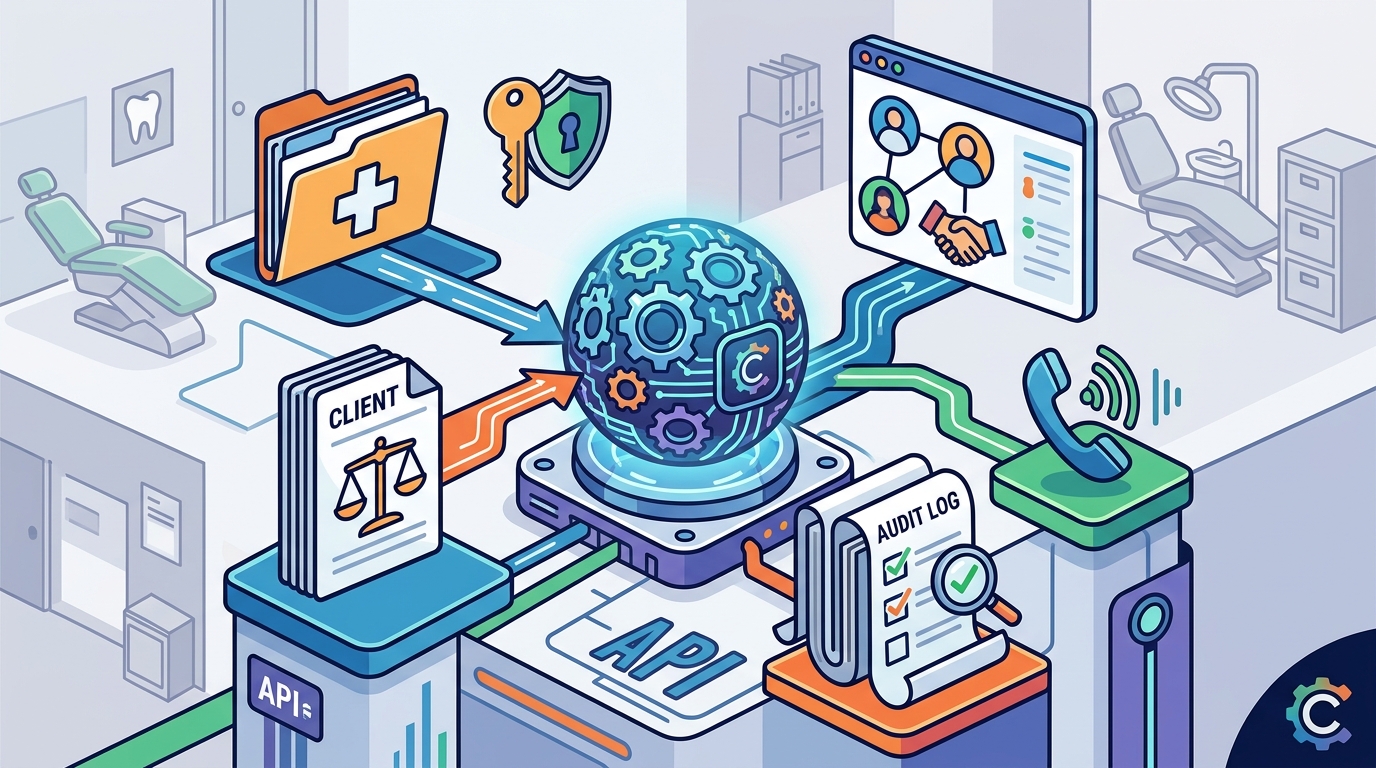
Connecting an AI agent to existing systems requires robust Application Programming Interfaces (APIs). An API is a set of protocols that allows different software applications to communicate with each other. For small businesses, seamless integration with Customer Relationship Management (CRM) and Electronic Medical Record (EMR) systems is critical for operational efficiency.
CRM Connectors for Workflow Automation
CRM systems store client interactions, billing data, and communication history. AI agents can use CRM APIs to retrieve this data, identify missing information, and prepare follow-up tasks. For example, an accounting firm can use an agent to track which client documents have arrived and which are still pending, reducing manual back-and-forth.
EMR Integration for Healthcare Practices
In dental and medical practices, EMR systems contain sensitive patient data. Integrating an AI agent with an EMR allows the system to access scheduling queues and patient records securely. This enables the agent to handle appointment requests and recall reminders without staff manually entering data into multiple systems.
HIPAA Compliance Requirements
Healthcare organizations must adhere to the Health Insurance Portability and Accountability Act (HIPAA). HIPAA compliance is a set of federal regulations designed to protect patient health information. For small practices, achieving and maintaining this compliance is a significant operational challenge.
Data Handling and Security
Any AI system handling patient data must implement strict security measures. This includes encryption of data in transit and at rest, as well as access controls that limit who can view sensitive information. Providers must ensure that their AI vendors sign Business Associate Agreements (BAAs) to legally commit to protecting this data.
Scope and Limitations
It is important to note that adapting a workflow to internal policies does not automatically certify compliance with federal regulations. Businesses must work with legal counsel and compliance experts to ensure their AI deployments meet all HIPAA standards. Cogsmith focuses on compliance-posture design, helping practices structure their AI workflows to align with these regulatory frameworks.
Voice Agent Platforms
Voice agents are AI systems capable of handling inbound and outbound phone calls. A voice agent platform is a software solution that provides the infrastructure for real-time voice interaction, including speech-to-text and text-to-speech capabilities. For small businesses, voice agents can handle routine inquiries, freeing up staff for more complex tasks.
Voice Infrastructure and Usage
Implementing voice agents requires specific infrastructure to handle call routing, latency, and audio quality. Pricing for these services is often tiered by usage volume, with rates determined by the number of minutes used. Businesses should evaluate their expected call volume to scope a realistic budget for voice automation.
Comparison of Engagement Models
| Industry Focus | Regulated SMBs (Health, Legal, Finance) | General Enterprise or Consumer |
| Compliance Support | Integrated audit trails and guardrails | Basic security, limited regulatory focus |
| Integration | Pre-built CRM/EMR connectors | Generic APIs requiring custom development |
| Oversight | Human-in-the-loop for high-stakes actions | Variable, often fully automated |
Key Takeaways
- Custom AI builds for regulated businesses must include compliance audit trails to demonstrate accountability.
- APIs are essential for connecting AI agents to CRM and EMR systems, enabling seamless data flow.
- HIPAA compliance requires strict data handling practices and Business Associate Agreements with AI vendors.
- Voice agent platforms provide the infrastructure for real-time phone interaction, priced by usage volume.
- Human-in-the-loop oversight is critical for high-stakes actions in regulated industries.
- Vertical AI providers offer pre-built connectors and compliance features that general platforms lack.
- Businesses should start with a focused pilot to measure the impact of AI on specific workflows.
Frequently Asked Questions
What is a vertical AI agent?
A vertical AI agent is an AI system designed specifically for a particular industry, such as healthcare or legal services. It is built to understand the unique workflows, compliance requirements, and data structures of that sector.
How do AI agents handle sensitive patient data?
AI agents handle sensitive data by using encrypted connections and strict access controls. They operate within defined scopes, and any action involving sensitive data is logged and often requires human review.
Can AI agents integrate with existing EMR systems?
Yes, AI agents can integrate with existing EMR systems through APIs. This allows the agent to access scheduling and patient data securely, enabling tasks like appointment management and recall reminders.
What is the cost of a custom AI build?
The cost of a custom AI build varies based on the scope of work, integrations required, and usage volume. Pricing is often quote-based, with retainer models for ongoing operations and hourly rates for implementation.
Do AI agents replace human staff?
No, AI agents do not replace human staff. They handle repetitive tasks, allowing staff to focus on high-value activities. Human oversight remains in the loop for all consequential actions.
How long does it take to deploy an AI agent?
Deployment time depends on the complexity of the workflow and integrations. A focused pilot can be scoped in a few weeks, with full production deployment following after successful testing.
Conclusion
For small businesses in regulated industries, finding the right AI partner is crucial. Cogsmith provides vertical AI agents that connect to your CRM or EMR and include voice calling, all while maintaining strict compliance standards. By focusing on one recurring workflow and ensuring human oversight, you can safely integrate AI into your operations. To plan your visit, start with our intake form to share your workflow and scope a pilot.